AUSTRALIAN MILITARY World War II –
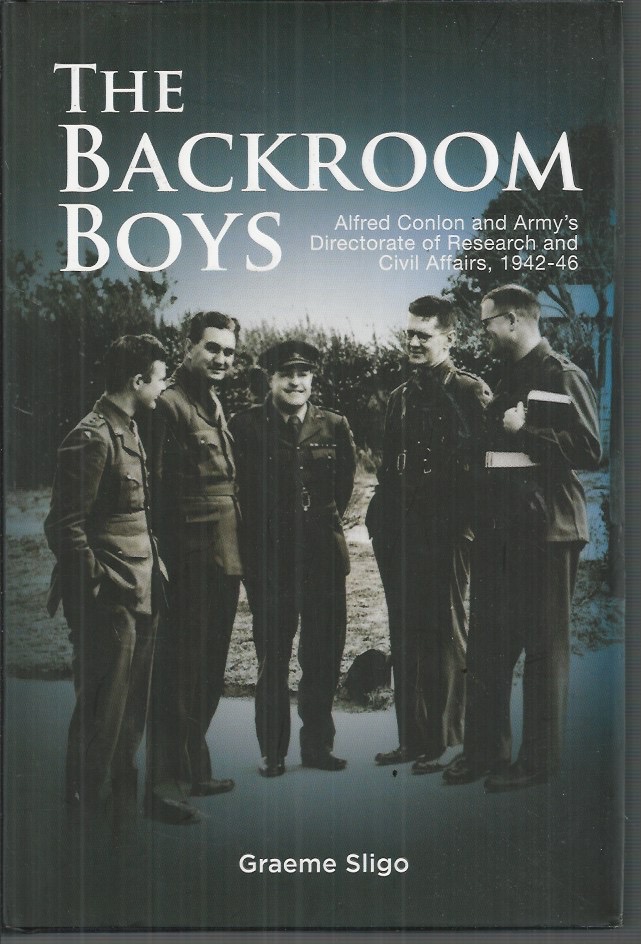
The Backroom Boys is the remarkable, but little known, story of how a varied group of talented intellectuals, drafted into the Australian Army in the dark days of 1942, provided high-level policy advice to Australia’s most senior soldier, General Blamey, and through him to the Government for the remainder of the war and beyond. This band of academics, lawyers and New Guinea patrol officers formed a unique military unit, the Directorate of Research and Civil Affairs, under the command of an eccentric and masterful string-puller, Alf Conlon.
The Directorate has been depicted as a haven for underemployed poets or meddlesome soldier-politicians. Based on wide-ranging research, this book reveals a fuller and more fascinating picture. The fierce conflicts in the wartime bureaucracy between public servants and soldiers, in which the Directorate provided critical support to Blamey, went to the heart of military command, accountability and the profession of arms.
The Directorate was a pioneer in developing approaches to military government in areas liberated by the combat troops, as demonstrated by the Australian Army in New Guinea, and Borneo in 1945-46. It is an issue of enduring importance. The Directorate established the Australian School of Pacific Administration, and had an important role in founding the Australian National University.
Its influence extended into post war Australia. The Backroom Boys emphasises the personality of Colonel Alf Conlon, as well as the talented men and women he recruited. Above all, this book shows how, unexpectedly, the Australian Army fostered a group of men and women who made a lasting contribution to the development of Australia in the decades after the war.
Review:
Although Colonel Graeme Sligo has written an interesting story about the Australian Army’s Directorate of Research and Civil Affairs, the real story that needs to be told is that of the directorate’s enigmatic director Alfred Conlon, at least beyond the glimpses into his personality that appear in the book.
The directorate started its existence as a small section reporting to the Adjutant-General, then Major-General Victor Stantke. Conlon, formerly the manpower officer at Sydney University, was commissioned as a major to head the directorate, and stayed with it through most of its tenure existence, being promoted progressively to colonel as the directorate expanded.
In an early excursion beyond the Adjutant-General’s Branch, Conlon also chaired a Committee on National Morale operating under the Prime Minister’s Department. The principal outcome of this committee seems to have been a report on education, elements of which were later adopted through the Universities Commission. This set the precedent for other activities by the directorate, some not of direct relevance to winning the war. Some of these should have been conducted by other parts of the Army or by other organisations, but Conlon had access to resources and personnel they did not.
While, for example, it was appropriate that the directorate provide advice on the legal framework for contingency planning in regions of Australia that might be invaded, the Army’s surveyors or the Department of External Territories could have conducted other projects, including construction of a terrain model of northern Australia and consolidation of Papua and New Guinea legal systems.
After nearly being sidelined by Stantke’s replacement, Major-General Charles Lloyd, Conlon saved his organisation by having it moved to the CGS Branch. From there, he liaised with government ministers, including Eddie Ward, Minister for External Territories, and the erratic Bert Evatt, Minister for External Affairs, while supporting General Thomas Blamey in his roles as Commander-in-Chief of the Army and Land Commander under General Douglas MacArthur.
Sligo covers in detail the dispute in 1942 and 1943 between Blamey and then secretary to the Department of the Army, Frank Sinclair. Blamey, with Conlon’s advice, was successful in delaying the re-introduction of the Military Board until after the war, yet the division of financial responsibilities between the secretary and the senior military commander, at the core of the dispute, remained unresolved for decades after the war.
Probably the directorate’s most important achievement was the LHQ School of Civil Affairs, later the Australian School of Pacific Administration, which trained personnel for civil affairs units. Deployment of civil affairs staff to British North Borneo, however, was complicated by Conlon’s willingness to support a plan by Evatt to bring North Borneo under Australian post-war administration. This plan seems to have involved first gaining Australian control over North Borneo, which would then be exchanged for Dutch New Guinea (West Papua).
Another example, which might seem outlandish to modern eyes, was a directorate proposal for increased Australian administrative responsibilities in Timor. Conlon’s ambition was for Australia to become ‘an almost “paramount power” in the South Pacific’. Sligo notes that Blamey, who had ‘a practical view of “troops to task” and military priorities’ probably told Conlon that the latter policy was impractical.
Sinclair’s desire for greater scrutiny of the Army’s activities could well have been justified given the tenuous connection between the problems of an army with limited resources and some of the directorate’s activities. The resources directed into the Papua and New Guinea legal system consolidation project, and establishing the Australian National University and the John Curtin School of Medical Research might have been better directed as higher priority tasks.
While Conlon was intellectually brilliant, his attitudes suggest a less than reflective personality. His reported statement that Blamey ‘did not have a clue who was up who in Canberra’ indicates that Conlon was either inflating his own ego, or that he did not understand the degree to which Blamey had been immersed in politics before the war and in the Middle East. While, as Peter Ryan commented, Conlon might have had up-to-the-minute knowledge of ‘who was up who’, Blamey was no slouch in that department.
Sligo notes Churchill’s comment that scientists (and by extension advisers like Conlon and his Directorate) should ‘be on tap, not on top’, but Conlon might not have shared that opinion. Indeed, while Conlon seems to have seen himself as some kind of puppetmaster, Blamey could actually have been pulling the strings.
Blamey was distrusted, in some cases actively disliked, by some Australian Labor Party ministers, and might therefore have used Conlon as a go-between. Conlon had influence with and kept close to senior Labor figures, including then prime minister John Curtin. Sligo records that Conlon was concerned that Curtin’s death might cause all his plans to come to naught as he was not as close to Curtin’s replacement, Ben Chifley, who also did not share some of Evatt’s ambitions. Sligo notes that ‘in many respects [Conlon] behaved as if he were a ministerial or political policy staffer’, not an apolitical military officer.
Conlon’s personality also caused dissent in the Directorate, with the anthropologist (and previous commander of the North Australia Observer Unit) Lieutenant-Colonel W.E.H Stanner, being posted to London to put distance between them. Some other staff members seemed less than convinced by Conlon’s plans, as did some outsiders who dealt with him, including influential economist and powerful public servant H.C. Coombs. Many of the Directorate’s staff, however, later went on to high academic or bureaucratic achievement (one, the later Sir Arthur Tange, becoming the bête noire of many military officers during his Department of Defence reform process).
In retrospect, it might have been better had Lloyd got his way, and Conlon and his then small group been despatched to the suburbs of Melbourne. Those tasks conducted by the directorate that really mattered, such as training civil affairs staff, would still have been done by other parts of the Army and the bureaucracy, while Conlon’s assertive and manipulative personality would have been removed to the sidelines.
Overall, The Backroom Boys is an interesting book providing insights into the working of the Directorate of Research and Civil Affairs, but it leaves open too many questions about its long-serving director Alfred Conlon.