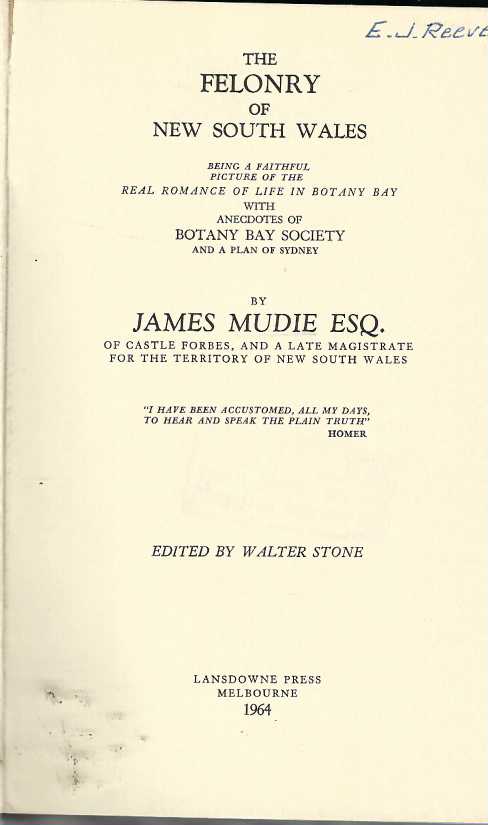
James Mudie’s The Felonry of New South Wales. Mudie’s book, published in 1837 after he was forced to return to England in some disgrace, viciously attacked many prominent members of New South Wales society.
James Mudie (1779–1852) was a Scottish-born settler who was offered free passage to Australia by Sir Charles Forbes in 1822. He was given a land grant on the Hunter River, which he turned into a productive agricultural establishment, employing convicts and an overseer, John Lanarch. In 1830 he was appointed a Justice of the Peace, and quickly gained a reputation for severity and excessive flogging.
In 1834, following the escape of six convicts on Mudie’s farm, Mudie and Lanarch were investigated for their treatment of their convict workers. No charges were laid, but the investigators, John Hubert Plunkett and Frederick Hely, criticised the rationing and overall treatment of convicts on the farm. Their criticism was followed by another attack, by William Watt, a ticket-of-leave convict, who published a pamphlet denouncing Mudie’s treatment of convicts. Mudie responded with attacks against Watts, Governor Bourke, and Roger Therry, who had defended the mutineers at their trial. Mudie was not reappointed to the Commission of the Peace, and he returned to England in 1836 after selling his property. In 1837 he published The Felonry of New South Wales.
xiv, 215 p., [1] folded leaf of plates : Sydney 1836 map ; 23 cm. (ex-library copy with minimal markings. Prev ownership name, no dustjacket)
Bourke, Richard, Sir, 1777-1855. | Convicts — New South Wales. | New South Wales — History — 1788-1851.